Contact Us
"*" indicates required fields


Where Marin Meets the Bay
Where Marin Meets the Bay
Originally constructed in 1942, 3030 Bridgeway emerged during one of the most pivotal periods in Sausalito’s history.
Built in just six weeks by the U.S. Army Corps of Engineers, the building was developed to support the rapid expansion of the Marinship shipyards, a vast wartime industrial complex created along Richardson Bay to meet the nation’s urgent shipbuilding needs.
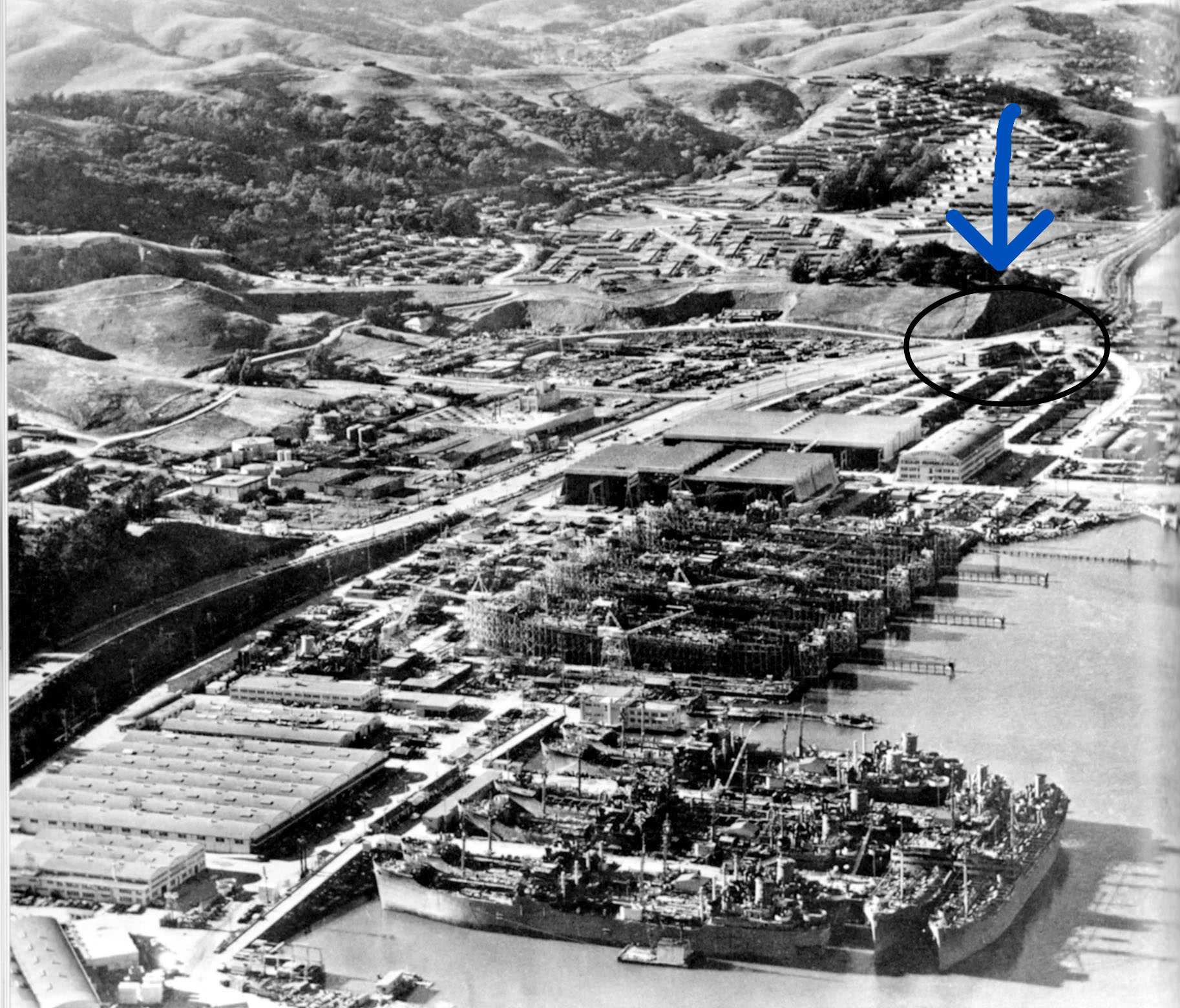
Photo courtesy of Sausalito Historical Society
This photograph, donated to the Historical Society by Steve Bechtel, shows the shipyard in full production. Bechtel proudly displayed the image in his [3030] office for many years.
Before it was known by its numerical address, the property was referred to as the “building at Waldo” and later interchanged as the Waldo Building, a reference to nearby Waldo Point, the location selected by the U.S. Navy for the Marinship yards. Contemporary reporting by the Sausalito News documented the building’s early importance, noting that it quickly became the headquarters of the Marinship Corporation, which relocated its offices from San Francisco’s Mills Building shortly after construction was completed. From this vantage point, Marinship oversaw one of the most productive emergency shipbuilding efforts in the country, delivering cargo ships and tankers at unprecedented speed.
As World War II came to an end and Sausalito began its transition away from heavy industry, the building evolved alongside the waterfront community. By the mid‑1950s, the former Marinship headquarters had been adapted for commercial use and became associated with Project Mart, a business services and professional center. During this period, the building was commonly referred to by locals simply as “The Mart,” a name that reflected its role as a shared hub for offices, training programs, and commercial activity.
A significant refurbishment in the late 1950s introduced interior upgrades, exterior painting and stucco work, and prominent signage along Bridgeway, marking a new chapter for the building while maintaining its strong visual presence on the waterfront. In the decades that followed, 3030 Bridgeway continued to support professional, educational, and office uses, demonstrating a rare continuity of purpose through changing economic eras.
Today, 3030 Bridgeway stands as one of the few remaining physical links to Sausalito’s Marinship era—a thoughtfully modernized office property that blends historic significance with contemporary functionality, and reflects the city’s transformation from wartime shipyard to one of Marin County’s most distinctive waterfront destinations.

Sausalito News, Volume 57, No. 24, June 18, 1942

Sausalito News, Volume LXXI, No. 3, January 20, 1956
Article text transcribed below
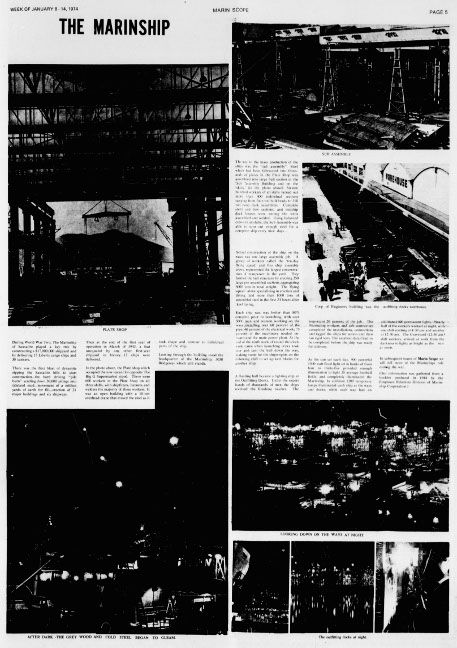
Sausalito Marin Scope, Volume 3, Number 37, 8 January 1974
During World War Two, The Marinship of Sausalito played a key role by constructing a $17,000,000 shipyard and by delivering 15 Liberty cargo ships and 30 tankers. There was the first blast of dynamite ripping the Sausalito hills to start construction… the hard driving “pile butts” sending down 30,000 pilings into tideland mud…movement of a million yards of earth for fill…erection of 21 major buildings and six shipways.
Then at the end of the first year of operation in March of 1943, a feat unequaled by any other first-year shipyard in history… 12 ships were delivered. In the photo above, the Plate shop which occupied the now vacant lot opposite The Big G Supermarket stood. There were 600 workers in the Plate Shop on all three shifts, with shipfitters, burners and welders the majority of those workers. It was an open building with a 10-ton overhead crane that moved the steel as it took shape and contour to individual parts of the ship. Looking through the building stood the headquarter of the Marinship, 3030 Bridgeway which still stands.
The key to the mass production of the ships was the “sub assembly.” Steel which had been fabricated into thousands of pieces in the Plate Shop was assembled into large hull section in the ‘Sub Assembly Building and on the ‘skids’ (in the photo above). Sixteen hundred workers of all skills turned out more than 400 individual sections ranging from four-ton bulkheads to 310-ton poop deck assemblies. Complete stern and bow sections, and midship deck houses were among the units assembled and welded. Using balanced crews on all shifts, the Sub Assembly was able to turn out enough steel for a complete ship every nine days.
Actual construction of the ship on the ways was one large assembly job. A group of workers called the ‘ten-day flying squad’ and five ship assembly crews, represented the largest concentration of manpower in the yard. They formed the hull structure by erecting 250 large pre-assembled sections aggregating 5000 tons in total weight. The ‘flying squad’ alone, specializing in erection and fitting, laid more than 1000 tons of assembled steel in the first 24 hours after keel laying.
Each ship was better than 80% complete prior to launching, with over 5000 men and women working on the ways installing over 60 percent of the pipe, 40 percent of the electrical work, 75 percent of the machinery needed onboard and the main power plant. At the end of the ninth week of round-the-clock work came when launching crews took over and sent the hull down the way, making room for the shipwrights on the following shift to set up keel blocks for another ship.
A floating hull became a fighting ship at the Outfitting Docks. Under the expert hands of thousands of men the ships received the finishing touches. The important 20 percent of the job. The Marinship workers and sub-contractors completed the installations, connections and rigged the ships for action and then ran rigid tests. The smallest detail had to be completed before the ship was ready for delivery.
As the sun set each day, 900 powerful 1500-watt flood light set in banks of from four to thirty-five provided enough illumination to light 20 average football fields, and completely illuminated the Marinship. In addition 1200 temporary lamps illuminated each ship at the ways and docks, while each way had an additional 600 permanent lights. Nearly half of the workers worked at night, with one shift starting at 4:30 pm and another at 12:30 am. The Graveyard (12:30 am) shift workers, arrived at work from the darkness to lights as bright as the sun at noon.
In subsequent issues of Marin Scope we will tell more of the Marinships role during the war. (Our information was gathered from a booklet produced in 1944 by the Employee Relations Division of Marin ship Corporation.)